During my recent visit to Toronto, Canada, I unwittingly received a profound education about the Indigenous communities there — particularly the First Nations, Inuit, and Métis peoples. It’s something we’re rarely exposed to in the UK, beyond major headlines.
Quite serendipitously, my trip coincided with Canada’s National Indigenous History Month. Throughout my time there, I had several spontaneous events and encounters that opened my eyes to the rich history, ongoing struggles, and invaluable wisdom of the Indigenous communities. From learning about the land disputes and environmental challenges to witnessing the resilience of their vibrant cultures, there was a lot to uncover.
In this blog post, I’d like to share a few of the experiences I had on the trip, as I believe there’s much we can learn from the perspectives and stories of Indigenous peoples.
Uncovering important titbits at Spadina House
On my first day in the city, I decided to go to Spadina House: a stately home that’s now kept as a museum, preserved with its 1920s style. The house had belonged to the Austin’s, an Irish family that immigrated to Toronto in the early 1800s.
A fun fact I found out was that the house had actually been named after the Anishinaabemowin word “ishpadina” (one of the oldest Indigenous languages in North America), meaning “highland” or “ridge”, due to its location at the top of a ravine that overlooks the city.
The museum respectfully provides information and recognition of the Indigenous land it was built upon — something I noticed at several other locations throughout the city. Land acknowledgment is something the city of Toronto is committed to, for continued awareness of the past and as a step forward in the reconciliation process.
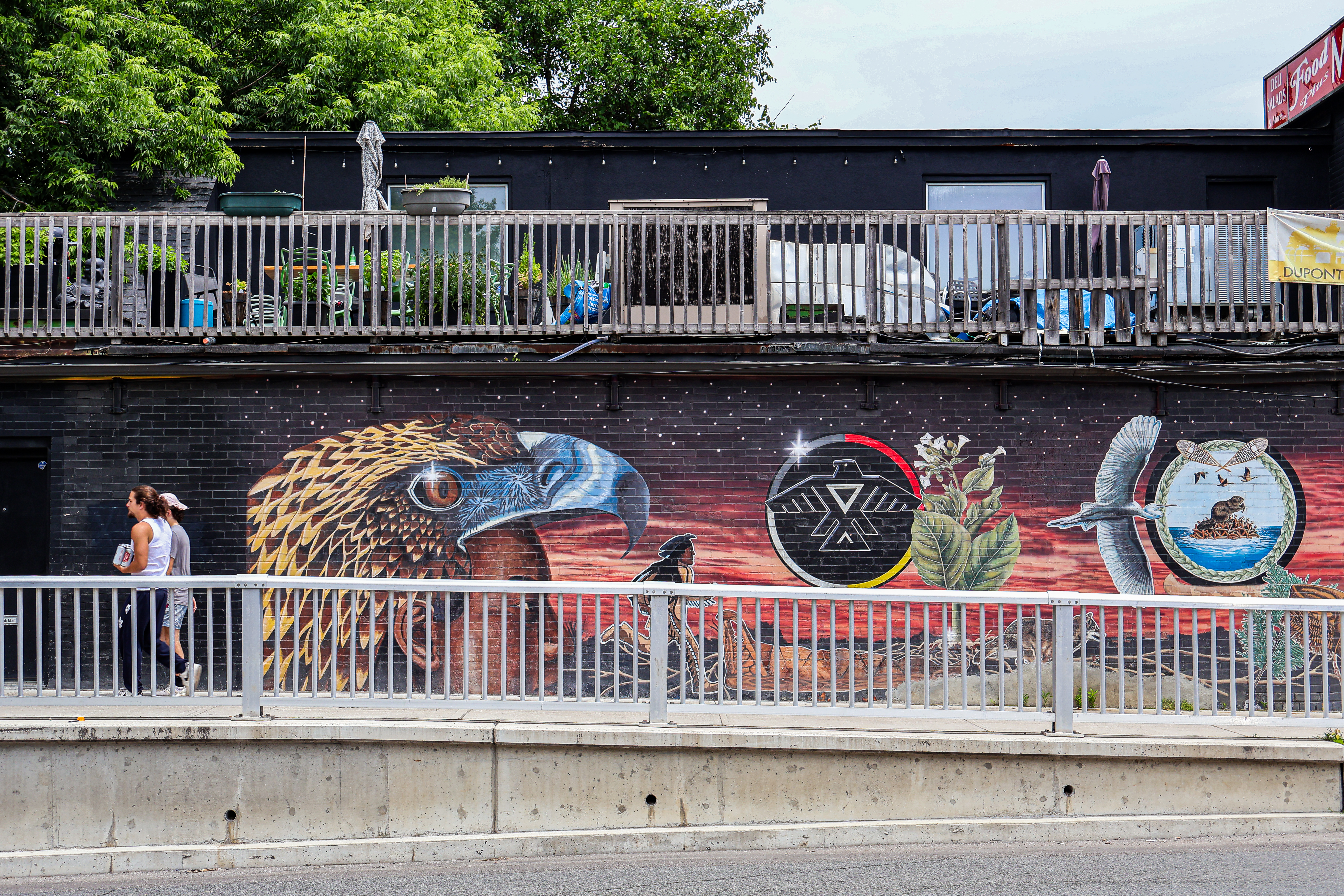
Celebrating Indigenous music at TD Massey Hall
Whenever I’m in a new city, I’m always on the hunt for live jazz. One evening, I happened upon a wonderful bohemian spot, the Cameron House, where the music was fantastic and the crowd was incredibly friendly. One of the musicians I met there invited me to their gig the following evening at the legendary Massey Hall — Toronto’s oldest and most respected music venue. Of course, I jumped at the opportunity.
Until I arrived, I had no idea what the event was. Turns out, it was the International Indigenous Music Summit — the largest global event dedicated to creating awareness, celebrating and promoting music and opportunities for Indigenous peoples. Musicians from all over the world descended in Toronto to participate in the festival and celebrate their ancestry. It was a powerful, moving evening, with many of their personal experiences shared through the music.
Flipping the narrative on the Sixties Scoop
Over a week into my trip, I’d spent a lot of time inadvertently learning about the Indigenous peoples of Canada. Even when I visited the Art Gallery of Ontario, I ended up spending most of my time among the First Nations, Inuit, and Métis collections. It was totally different from the art history we’re given in Europe.
Still frustrated at my general lack of knowledge on the subject and wanting to learn more, I headed to Toronto’s Public Library. I was about half an hour into reading when an announcement was made: in 15 minutes there would be a free screening of a film to celebrate National Indigenous Day and Pride Month, and everyone was welcome! Yet another serendipitous moment, I thought.
After finishing the section I was reading, I headed downstairs to the screening room. Before the movie started, the Elder hosting the event asked the audience to stand in a circle while she carried out an ancient ritual called smudging. Herbs and tobacco are burned while the Elder used a feather she had inherited from the grandmother to waft the smoke over us, one at a time, as a cleansing process. It was beautiful to be a part of.
The movie was hard-hitting. Set in the 80s, the protagonist Rosie — also the name of the movie — is a victim of the shocking Sixties Scoop. The process of “scooping” Indigenous children from their homes continued for far too long, unbelievably right up until 1996. They were placed in orphanages or boarding schools where they were brutally forced to relinquish their identities and adopt European practices and beliefs. If you saw the headlines (that did make it across the pond) a few years ago, you’ll know that hundreds of the children never came out alive.
When writing Rosie, queer, Métis filmmaker Gail Maurice wanted to flip the narrative on the Sixties Scoop, and the representation of Indigenous peoples on the screen in general. Instead of always being the victim, always suffering, Gail wanted to promote messages of hope, strength and love — also within the drag scene which was and still is very active in Toronto.
I’m so grateful to have had the opportunity to watch Rosie — it was incredibly emotional but also uplifting.
Indigenous practices could help fight climate change
The main reason I was in Toronto was to attend Collision 2024, hosted by Web Summit. Equality and diversity are clear values for them and something they never fail on. It was no surprise therefore, to see several Indigenous speakers on the line-up, Nathalie Kelley being one of them.
Actress of Quechua descent, Nat was given space on the main stage to talk about how big tech won’t save us. She enlightened the audience about Indigenous practices that enabled people to live for hundreds of thousands of years, in harmony with the earth, not causing any damage and not running out of resources either.
I sat down with Nat after her talk to find out more about low tech solutions that served Indigenous communities well. Here are two examples she gave me:
Tenochtitlan, capital of the Aztec Empire
Tenochtitlan, today Mexico City’s historic centre, was once the capital of the Aztec Empire and the cleanest city in the world. Living on an island with limited space, the Aztecs designed chinampas (floating gardens) using woven reeds, mud, and decaying vegetation. Fertile and well-irrigated, the chinampas provided a highly efficient system for growing crops like maize, beans, squash, and chili peppers, with multiple harvests per year that supported the entire urban population. They also had an incredibly sophisticated water and waste management system.
“It was genius,” says Nat. “And it was aesthetically beautiful. When the Europeans arrived, they wrote about how impressed they were.” Why they then proceeded to destroy it seems ridiculous, but that’s colonialism for you.
The Amazon Rainforest
“The Amazon rainforest is a bioengineered, human-made, food forest, created using tech using black earth. The soil of the Amazon is traditionally very poor for growing food, but using direct observation of the natural world and the relationships of the web of life, my ancestors understood that you could create a specific type of soil using char and waste. And with that soil they built the biodiverse wonder that is the rainforest today, home to the largest biodiversity on the planet,” explains Nat.

Amplifying voices that need to be heard
It’s clear that Canada is doing a lot to improve education around Indigenous culture and history, with the aim of providing a better present and future for these communities. There’s still a long way to go but hopefully the more we all talk about it, the more positive progress will be made.

 Emily D'Silva
Leave a comment