How can we solve climate change? It’s a complex question to answer, but one solution is carbon capture.
From planting trees to adopting regenerative agriculture practices, many strategies are used to help reduce atmospheric CO2 levels. But did you ever consider that art could be a powerful tool in this fight?
For artist Vladmir Kanic, when creating living sculptures, capturing carbon was not an initial goal. But with his education in computer science, career in multidisciplinary arts and a deep love of nature, he had the perfect formula to create climate-positive algae sculptures. I felt so inspired upon meeting Vladimir, seeing his sculptures and learning about his story.
When life gives you lemons… make lemonade
It all started when Vladimir moved to Canada from Croatia to study interdisciplinary arts at OCAD University. With a scientific mindset, he was motivated to take environmentally specific courses, researching deeper into biology, chemistry, and genomes. But two months into his new life abroad, the pandemic hit.
Lockdown was a very different experience for everyone. For Vladimir, although frustrated at not being able to go out and meet people in the new city, he embraced the new norm and took advantage of having time at home to himself. “The best thing about approaching a problem as an artist, is that you have a different mindset on how to solve the problem,” admits Vladimir.
At the time, he had three boxes of seaweed in his fridge, which he enjoyed eating. However, he discovered that when you cook it, it releases a sort of gelatin. Putting his scientific brain to work, Vladimir began experimenting with this new substance. He cultivated an algae farm in his tiny bathroom, and continued experimenting. Eventually, he managed to process it in a way that created a malleable, plastic-like material.
It was a totally new medium for him to work with, but Vladimir sees this as an advantage: “When you switch mediums and work with something you’re unfamiliar with, you come at it with a new perspective. There’s an advantage because you don’t have to follow the rules or unlearn anything. Experimentation and playing about is the best way to achieve something unique.”
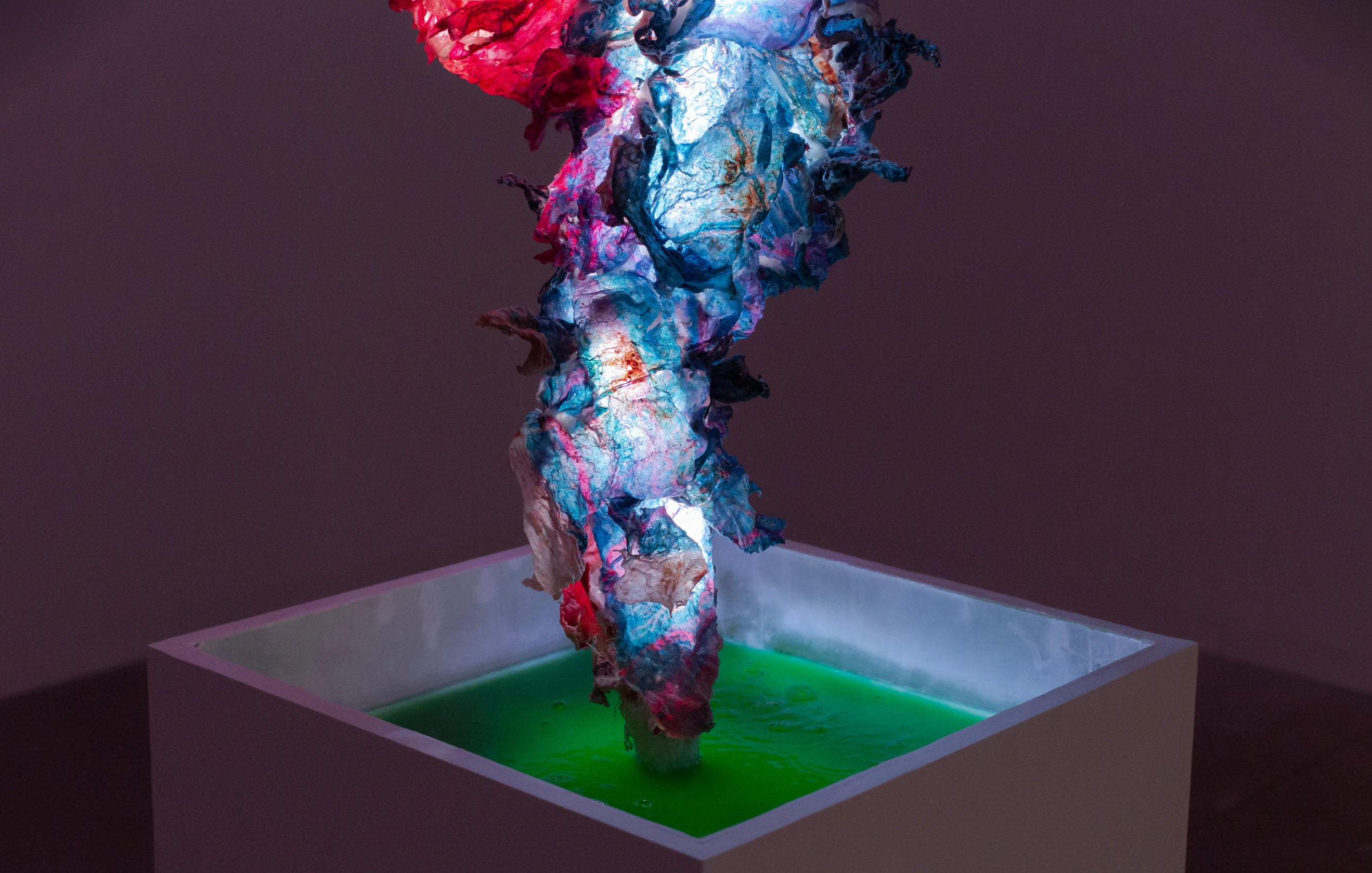
And that’s exactly what he’s done: created beautiful, unique living sculptures from algae.
An enlightening experience under the sea
Going back to Vladimir’s childhood, he spent a lot of time diving and competitive swimming. “It’s a rush that’s addictive. And when diving, I have this clarity of mind, feeling that I could see for miles and miles”, describes Vladimir.
The sea has a strong cultural element for Croatians. Vladimir’s grandfather used to tell him that if Vladimir ever wanted to talk to him when he was gone, he could ask the sea a question and the waves would answer. Hearing this advice from his grandfather, he continued diving to search for his grandfather, father, and others he loved who had passed away.
When it came to experimenting with algae during lockdown, it was a full-circle moment. “I think I was subconsciously trying to recreate a piece of my island by building these sculptures that resembled the ocean,” says Vladimir. “And the more I work with algae, the more I think of them as collaborators rather than just the material that I use to create with.”
To shock or inspire change?
Throughout time, art has always had the unique power to influence social change. Now, modern artists and activists are using it to create environmental change. Too often, however, a shock factor is used to provoke thought, challenge societal norms, and spark a strong reaction from the viewer.
While this worked well in the past, nowadays, almost every headline, ad, or video we see online is click-bait designed to shock and entice us. As a result, many of us have become immune. Yet still, climate extremists go around defacing artwork, but it begs the question: if shock and anger are the main reactions they’re evoking, what are they hoping to achieve?
“My opinion changed,” explains Vladimir. “At first, I thought we should use every means possible to raise awareness awareness around environmental issues. But they’re doing exactly what we don’t want by shocking people – and so the doctrine of hope is replaced with more shock. I think change has to be inspired rather than shocked and chiseled into people.”
Vladimir continues, “I want to use the art to inspire social action, but also to elicit hope. When I walk into an art gallery, I want to feel alive. I want it to give me back a sense of humanity”.
True to his own desires, visitors at Vladimir’s exhibitions can experience this human, hopeful feeling of being alive, simply by breathing. His sculptures have a base of live algae that thrive when the visitors breathe — capturing the carbon dioxide and replacing it with oxygen. It’s an almost meditative exchange that motivates people to begin thinking about their own environmental solutions and inspires them to take positive action.
Let it grow, let it grow, let it grow
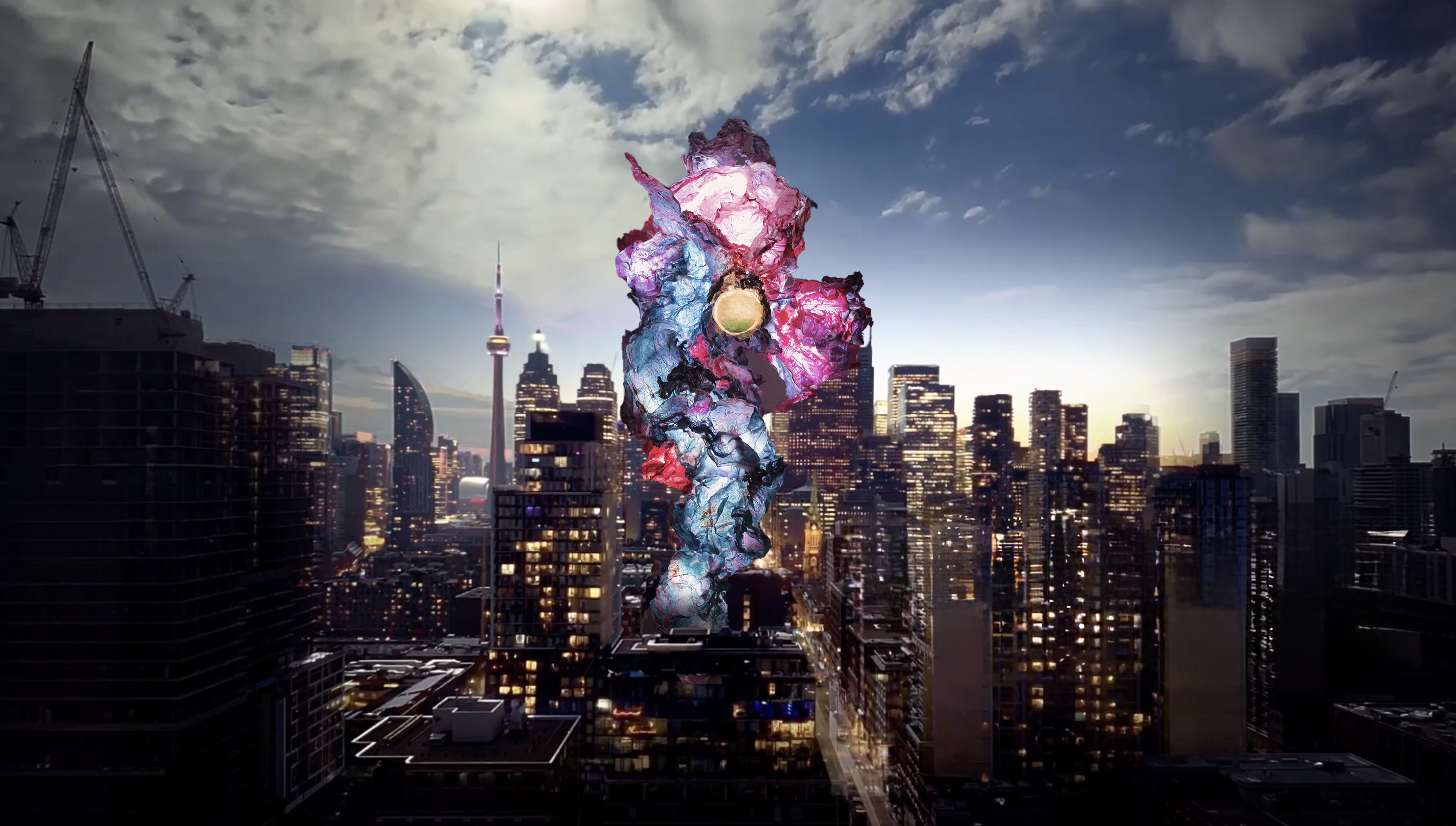
The algae journey for Vladimir doesn’t end there. With further experiments, a bit of luck and intuition, Vladimir has additionally created Solid-State Carbon — a material that grows directly from atmospheric carbon instantaneously. He’s won awards from Enbridge, a large Canadian energy company and CSA Group (Canada Standards Association) for the material, with ISO certification pending.
The idea is to scale up to the point of growing buildings instead of constructing them. “I’m looking at the whole ecosystem of how we create things, from construction to 3D printing to then growing,” shares Vladimir. “These buildings I’m envisioning would be storage units for atmospheric carbon. We would be transforming carbon into something useful, like housing, as well as carbon-capturing public art installations.”
Click here to find out more about Vladimir’s work.

 Emily D'Silva
Leave a comment